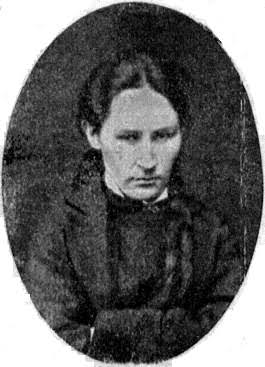
 Maria Alexandrovna Kolenkina (1850 – October 31, 1926) was a Russian socialist revolutionary and Narodnik (populist) active in the 19th-century anti-Tsarist underground.
Best known for co-planning the famous dual assassination attempts of 1878 alongside Vera Zasulich, Kolenkina spent decades in
exile and hard labor following her arrest by the Tsarist secret police.
Maria Alexandrovna Kolenkina (1850 – October 31, 1926) was a Russian socialist revolutionary and Narodnik (populist) active in the 19th-century anti-Tsarist underground.
Best known for co-planning the famous dual assassination attempts of 1878 alongside Vera Zasulich, Kolenkina spent decades in
exile and hard labor following her arrest by the Tsarist secret police.
Her life intersected closely with Catherine Breshkovsky—the legendary "Little Grandmother of the Russian
Revolution"—and highlighted the intense female-female bonds and non-traditional living arrangements common among radical Russian women.
Born into a merchant family in Lebedyan and raised in Temryuk along the Sea of Azov, Kolenkina traveled to Kiev in the early 1870s to study midwifery. At the time,
medical and midwifery courses were among the few avenues of higher education open to young Russian women, making these student circles hotbeds for radical political
thought.
In Kiev, Kolenkina joined the Bakuninist anarchist movement known as the Iuzhnye Buntari ("Southern Rebels") and became a key figure in the Kiev Commune. It was here
that she met Catherine Breshkovsky. Breshkovsky, who had recently abandoned her traditional noble marriage to pursue revolutionary work, formed an immediate political
and personal bond with Kolenkina.
In July 1874, Kolenkina, Breshkovsky, and fellow radical Yakov Stefanovich embarked on the famous khozhdenie v narod ("Going to the People") movement. Dressed as
itinerant peasant women carrying false passports, they traveled through rural villages to spread socialist ideas among the peasantry.
To explain their companionship while traveling on foot, the younger Kolenkina posed as Breshkovsky’s niece.
When police drew near, Kolenkina managed to slip away back to Kiev, while Breshkovsky was arrested in Kherson province due to her aristocratic carriage and refusal to
act submissively toward a police officer. Breshkovsky was subsequently sentenced to hard labor, making her one of Russia's first female political prisoners.
After evading arrest, Kolenkina moved to St. Petersburg under an assumed identity and joined Zemlya i Volya (Land and Liberty). In St. Petersburg, she lived in a close
domestic partnership with Vera Zasulich.
In January 1878, outraged by the brutal beating of a political prisoner by St. Petersburg Governor Fyodor Trepov, Kolenkina and Zasulich planned simultaneous
attacks:
Vera Zasulich shot and severely wounded Governor Trepov on January 24, 1878. Maria Kolenkina was tasked with assassinating Vladislav Zhelekhovsky, the prosecutor in
the infamous Trial of the 193. However, she was unable to approach Zhelekhovsky on the designated day.
Kolenkina returned to hiding but was cornered by Tsarist gendarmes on October 11, 1878. After a brief shootout, she was captured and imprisoned in the Peter and Paul
Fortress. In May 1880, she was sentenced to 10 years of katorga (hard labor) and internal exile in Siberia.
After serving her initial sentence, Kolenkina was released on probation in 1885 and settled in Tunka and later Irkutsk. While in Siberian exile, she married fellow
political exile Nikolay Nikolaevich Bogorodsky, an employee at the local geographical museum. Kolenkina worked as a school teacher in Irkutsk, where she lived quietly
until her death on October 31, 1926.
While 19th-century historical records rarely used modern queer or lesbian terminology, historians who study the Russian populist movement highlight significant
dynamics regarding gender, sexuality, and female intimacy in Kolenkina’s circle:
"The female Narodnitsy consciously rejected the heterosexual nuclear family and patriarchal authority, replacing them with egalitarian communes and intense, lifelong
partnerships with other women."
Figures like Breshkovsky explicitly abandoned traditional marriages and motherhood to enter underground radical networks. Living in female-led communes (such as the
Kiev Commune) was both a political statement and a practical necessity.
Women in these circles lived together in close-knit pairs—such as Kolenkina with Breshkovsky during their peasant expeditions, and later Kolenkina with Vera Zasulich
in St. Petersburg. These relationships featured deep emotional reliance, shared domestic spaces, and mutual devotion to political martyrdom.
In 19th-century Russian revolutionary culture, passionate same-sex emotional bonds—often termed "romantic friendships" or radical sisterhoods—were common and accepted
within underground communes. Historical consensus notes that while these relationships fulfilled romantic and intimate needs in spaces isolated from traditional society,
they existed outside modern self-identified "LGBTQ+" definitions.
Kolenkina’s bond with Catherine Breshkovsky and her later partnership with Vera Zasulich remain prime historical examples of how radical women relied on female
intimacy and non-traditional living structures to survive and operate in Tsarist Russia.
References:
- https://en.wikipedia.org/wiki/Maria_Kolenkina
- http://search.proquest.com/openview/c88bafc608b03a54f81dd88743a6c0b3/1?pq-origsite=gscholar&cbl=18750&diss=y
- https://www.scribd.com/document/872192066/Michael-Newton-Age-of-Assassins-the-Loners-Idealists-and-Fanatics-Who-Conspired-to-Change-the-World
Support this project
This website is a passion project researched, developed, and funded entirely by me. If you find the content valuable and would like to help support the ongoing research and hosting costs, any contribution is deeply appreciated.
Thank you for keeping this independent resource alive!
My books on Amazon: Elisa Rolle's books
BACK TO HOME PAGE